A TMT bar may spend most of its life inside concrete.
But before it reaches a construction site, it has to pass through something else:
Trust.
A contractor has to trust the manufacturer.
A dealer has to trust the brand.
A builder has to trust the product specifications.
A procurement team has to trust the documentation.
And increasingly, all of this research happens online before the first conversation even takes place.
That creates an interesting challenge for TMT manufacturers.
You may have a large manufacturing facility, decades of experience, advanced technology, multiple grades and strong distribution — but does your digital presence communicate all of that clearly?
This is where the work we have done with German TMT becomes particularly relevant.
Why does digital presence matter for a TMT manufacturer?
TMT is a technical product.
A customer isn't necessarily looking for flashy advertising.
They want answers.
Questions such as:
- What grades of TMT bars are available?
- What sizes are available?
- Where is the steel manufactured?
- What standards does the manufacturer follow?
- What technology is used?
- How is quality controlled?
- Is the manufacturer capable of supplying large projects?
- Does the company have experience?
- Where can the product be purchased?
- What makes one TMT manufacturer different from another?
These questions can influence a buying conversation long before a salesperson speaks to the customer.
And this is why digital marketing for steel manufacturers cannot simply mean posting product images on social media.
The digital presence needs to explain the business.
What should a TMT manufacturer actually show online?
A strong TMT brand should be able to take someone from:
“Who is this company?”
to:
“I understand what they manufacture.”
to:
“I understand how they manufacture it.”
to:
“I understand why this manufacturer can be considered for my requirement.”
That requires much more than a product catalogue.
It requires digital authority.
And that authority can come from several layers.
1. Show the manufacturing capability
A steel manufacturer should not hide its biggest asset behind generic stock images.
The manufacturing facility itself is part of the brand.
The scale of the plant, production systems, equipment, processes, people and quality-control infrastructure can all communicate something about the organisation.
German TMT, for example, operates manufacturing facilities in Gujarat, including its Viramgam facility, where it manufactures MS billets and TMT bars across multiple grades and sizes. Its parent group also operates a vertically integrated facility at Samakhiyali.
That is valuable information.
But simply having the facility isn't enough.
People need to see it.
That means professional:
- Factory photography
- Manufacturing videos
- Corporate films
- Process explainers
- Product photography
- Plant walkthroughs
- Quality-control content
- Technical content
A factory can be one of the strongest marketing assets a manufacturer owns.
2. Explain the technology behind the TMT bar
One of the biggest missed opportunities for industrial brands is assuming customers already understand the manufacturing process.
They don't always.
And even when they do, explaining the process properly creates an opportunity to differentiate the brand through knowledge.
German TMT's website states that its TMT bars are produced using Thermex quenching technology, and describes the process as producing a strong outer surface with a ductile core.
This is the kind of information that can become valuable digital content.
Instead of simply saying:
“We manufacture high-quality TMT bars.”
a brand can explain:
What technology is used?
What happens during processing?
Why does controlled cooling matter?
How does the manufacturing process relate to the properties of the finished bar?
That turns a product page into an educational resource.
3. Talk about grades in a way buyers can actually understand
TMT isn't one generic product.
Different grades have different specified properties and applications.
BIS materials describe grades including Fe 415, Fe 500, Fe 500D, Fe 550, Fe 550D and Fe 600, with specified mechanical requirements including yield/proof stress, tensile strength and elongation.
German TMT's published product information lists grades including Fe 500, Fe 500D, Fe 550, Fe 550D and CRS variants, with TMT bar sizes ranging from 8 mm to 40 mm.
But there is an important distinction here.
A manufacturer shouldn't simply create a page filled with grade names.
It should answer the questions buyers actually have.
For example:
What is Fe 500D?
How is Fe 500D different from Fe 500?
When is Fe 550 considered?
What does ductility mean in reinforcement steel?
How should engineers select the appropriate grade?
What should procurement teams check before ordering?
This is where SEO and AEO become particularly valuable for manufacturers.
You're not just trying to rank a product page.
You're trying to become the source that answers the question.
4. Make certifications and standards easy to find
For technical products, credibility cannot depend entirely on marketing language.
Documentation matters.
German TMT's published facility information lists standards and certifications including ISO 9001:2015, ISO 45001:2018, ISO 14001:2015 and BIS 1786:2008, among others.
Its website also has a dedicated section covering government approvals and certifications.
This is important because a manufacturer should make it easy for a potential buyer to verify relevant information.
Instead of burying certifications somewhere deep inside a website, brands can create a clear information architecture around:
Standards → Certifications → Testing → Quality → Products → Manufacturing
This makes the website useful to engineers, procurement teams, contractors and dealers.
5. Don't just say “quality”. Show the systems behind quality.
Almost every steel manufacturer can say:
“Quality is our priority.”
The more useful question is:
How?
What happens before the bar reaches the customer?
What raw materials are used?
What testing is conducted?
How is consistency monitored?
What standards apply?
How is production controlled?
What documentation accompanies the product?
The answers create stronger content than generic statements about quality.
For German TMT, its public information describes a vertically integrated manufacturing setup and quality-management certifications across its facilities.
That gives the brand an opportunity to turn manufacturing infrastructure into educational content.
6. This is where SEO becomes much more important for TMT manufacturers
Imagine a contractor searches:
“How to choose TMT bars for a building?”
Another person searches:
“Fe 500D vs Fe 550 TMT bar.”
Another searches:
“TMT bar sizes available in Gujarat.”
Another:
“What is Thermex technology?”
Another:
“How to check TMT bar weight and diameter?”
These aren't necessarily searches for a particular company.
They're questions around the category.
And that's exactly where a TMT manufacturer can build authority.
Instead of creating content only around:
“Buy TMT bars from us.”
the brand can build an entire knowledge ecosystem around reinforcement steel.
That's the difference between having a website and building digital authority.
7. German TMT is a good example of how this can work
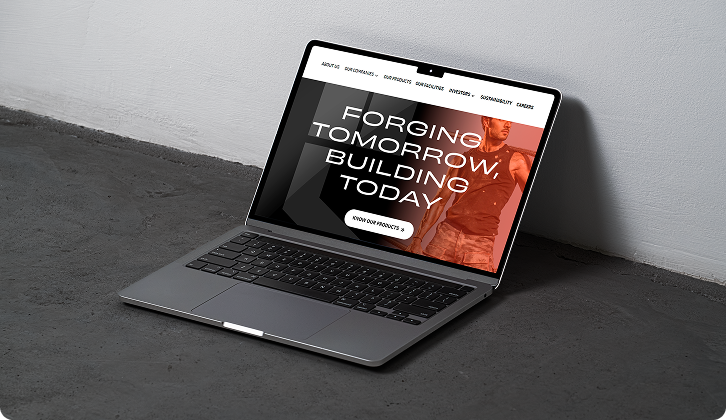
Our work with German TMT has gone beyond simply creating individual marketing assets.
We have worked on the brand's broader digital and communication ecosystem.
That includes branding, campaigns, social media, website, SEO and AI SEO — alongside the offline work that helped establish the brand's identity.
You can see more about our work in the German TMT case study.
One of the most recognisable elements of the brand has also been its “Haq Se German” communication.
That is an interesting example of how a technical manufacturer can build a more memorable consumer-facing identity without losing its industrial credibility.
8. A TMT manufacturer can be technical and memorable at the same time
This is an important balance.
A steel manufacturer shouldn't become so technical that nobody remembers the brand.
But it also shouldn't become so promotional that customers cannot find useful technical information.
The strongest communication can combine both.
For example:
Brand
“Haq Se German.”
Product
Fe 500D TMT Bars.
Technology
Thermex quenching technology.
Proof
Manufacturing facilities, certifications and quality systems.
Education
Technical content answering real buyer questions.
Visibility
SEO, social media, digital campaigns and AI search optimisation.
That's when branding and marketing start working together.
9. What does AI SEO add to a TMT manufacturer's strategy?
Search behaviour is changing.
People increasingly ask complete questions instead of typing only short keywords.
For example:
“Which TMT bar is suitable for a high-rise construction project?”
or:
“What should I check before buying TMT bars in Gujarat?”
or:
“What is the difference between Fe 500D and Fe 550D?”
This means manufacturers need content that is structured around questions, entities, explanations and evidence.
This is where AI SEO becomes relevant.
The objective isn't simply to put more keywords on a page.
It is to make the brand's information understandable and discoverable across modern search and answer environments.
10. What can a TMT manufacturer do with one factory shoot?
Quite a lot.
One professional production day can generate an enormous amount of content.
For example:
Factory photography
→ Website
→ Social media
→ Brochures
→ Sales presentations
→ Dealer communication
→ Google Business Profile
→ PR
→ Product pages
Manufacturing video
→ Corporate film
→ Instagram Reels
→ YouTube
→ Website hero video
→ LinkedIn
→ Dealer presentations
→ Sales meetings
Technical interviews
→ Blog articles
→ FAQs
→ Website content
→ AEO content
→ Social media
→ YouTube Shorts
This is why we believe manufacturing brands need a connected creative strategy.
11. What does a modern digital strategy for a TMT manufacturer look like?
It can look something like this:
Brand
Build a recognisable identity.
Website
Explain the company, products, manufacturing capabilities and proof points.
Content
Answer technical and commercial questions.
SEO
Capture relevant Google searches.
AEO
Structure content around questions and direct answers.
AI SEO / GEO
Build visibility across AI-driven discovery environments.
Social Media
Make the brand visible and memorable.
Photography & Video
Show the real people, products, technology and facilities behind the business.
Offline Marketing
Connect digital branding with dealers, contractors, events and physical communication.
And importantly, all of these should feel like one brand.
12. This is the approach we took with German TMT
German TMT wasn't treated as simply another steel manufacturer requiring social media posts.
The larger opportunity was to build a recognisable brand around the manufacturing business.
That meant connecting:
Branding
↓
“Haq Se German”
↓
Offline activations
↓
Digital campaigns
↓
Website
↓
SEO
↓
AI SEO
↓
Ongoing content and communication
The manufacturing business remained at the centre.
But the communication around it became much broader.
Why should TMT manufacturers invest in this now?
Because the steel business is becoming increasingly information-driven.
Before a customer contacts a company, they can already search its:
- Website
- Products
- Grades
- Certifications
- Manufacturing facilities
- Reviews
- Social media
- Projects
- Brand reputation
- Technical content
The question is no longer simply:
“Do you manufacture good steel?”
It is also:
“Can I find enough credible information about your company to understand and trust what you manufacture?”
That is a digital marketing question.
And it is increasingly a branding question too.
From the steel plant to the search result
This is the opportunity for modern TMT manufacturers.
Your strongest marketing asset may already exist.
It's your factory.
Your technology.
Your engineers.
Your quality systems.
Your certifications.
Your products.
Your experience.
Your people.
Your projects.
Your story.
The job of digital marketing is to take all of that and make it visible, understandable and discoverable.
That's what we work toward at Hypace Studios.
And our work with German TMT is one example of how a traditional manufacturing business can combine strong branding with digital marketing, SEO, AI SEO and content to build a more recognisable presence.
For TMT manufacturers looking to build that kind of connected ecosystem, explore our Marketing services, Branding & Visual Identity, Website & UI/UX Design and AI SEO.
The steel is manufactured in the plant.
The brand is built everywhere else.
Talk to Hypace Studios about building your manufacturing brand.
Frequently Asked Questions
How can TMT manufacturers improve their digital presence?
TMT manufacturers can build a stronger digital presence by combining a professional website, technical content, SEO, AI SEO, social media, factory photography, manufacturing videos, certifications and clear product information.
What should a TMT manufacturer include on its website?
A useful TMT website can include product grades and sizes, manufacturing information, technology, quality systems, certifications, testing information, applications, FAQs, company history, facilities and contact or enquiry options.
Why is SEO important for TMT manufacturers?
Potential buyers search for technical information, product grades, specifications, manufacturers and purchasing information online. SEO can help a manufacturer become discoverable for these relevant searches rather than relying only on brand-name searches.
How does AI SEO help steel manufacturers?
AI SEO focuses on making a brand's information structured, clear and authoritative enough to be understood and surfaced in AI-driven search and answer experiences, alongside traditional search visibility.
How does German TMT demonstrate manufacturing capability?
German TMT's published information identifies its Gujarat manufacturing facilities, multiple TMT grades and sizes, Thermex quenching technology and various quality-management and product standards.
What is Hypace Studios' role in German TMT's growth?
Hypace Studios has worked across German TMT's branding and communication ecosystem, including its digital presence, campaigns, website, SEO, AI SEO and offline brand communication. The German TMT case study provides more detail on the project.



.svg)


